

Written by: Corey Janoff
This post was originally published on our previous blog website on January 17, 2017 and has since not been revised and/or updated.
At the beginning of every year, you see numerous articles about what the best things to invest in were last year and what you should be investing in for the coming year. Simply Google, “Where to invest in 2017” and you will find no shortage of articles from all of the major publications and financial prognosticators.
I am sorry to disappoint you, but this blog post will not provide you with the secret sauce to make you rich over the coming year. It isn’t because I don’t want you to succeed as an investor – far from it. It is because I have no better idea than the next person as to which areas will be the best performing moving forward! Besides, if I really could predict the future, I wouldn’t be writing this blog post. I would be on my private island, trading my own personal portfolio and sipping a Mai Tai made from the finest of rums while my personal chef prepares me whatever my heart desires.
This post will discuss some of the untold truths of investing that the mass media doesn’t bother to disclose. You’re telling me news publications aren’t telling the real truth!? Why is that so, you ask? Well, with 24/7 news cycles, publications and broadcast companies are constantly seeking and need new content. If the content is the same over and over again, the stories run dry and consumers turn elsewhere. So here it is: the untold truths that the mass media fails to report.
Truth #1: Predicting the Future is Extremely Difficult
I heard a quote at a seminar I attended that I felt hit the nail right on the head. “Economic forecasting was created to make astrology look respectable.” I’m not sure who originally said it, but if someone can tell me, I am happy to give credit where credit is due. The point is, hardly anybody can accurately and consistently predict the future over extended periods of time.
The “experts” are no better than the average individual, or a monkey for that matter, at economic forecasting. The accuracy of expert predictions is about 50%, or that of a coin flip. Daniel Kahneman discusses this in his book Thinking Fast, And Slow. If you want a summary of the findings, read this article. If you are looking for proof, look up last year’s economic or stock market predictions and see how many of them were correct. So keep that in mind when reading predictions from the so-called “experts.”
Truth #2: Inflation is the Biggest Risk to Investors
Most people invest to grow their wealth over long periods of time. People investing to make a quick buck might as well be gambling at a casino, so we will ignore that subset of the population for this section.
When investors think about risk, they are most likely thinking about the probability that their investment will decline in value in the near future. However, the typical investor isn’t investing for the near future – they are investing for retirement. And getting your money to grow enough so you can retire one day is only half the battle. You need that money to last throughout retirement.
For a 40 year old that plans to retire at 60 and hopefully live into his 90’s, he needs some of his money to last another 50+ years! The biggest risk isn’t his investment declining in value in the near future. The real risk is his loss of purchasing power over time.
Inflation causes prices to rise over time. Look back at what household goods cost when you were younger. In 1990, a stamp cost $0.25, a gallon of gas cost $1.16, and the cost of a dozen eggs was $1 (via 1990sflashback.com).
In America, we have experienced relatively consistent inflation averaging about three percent per year, historically. What that means is, the $4 gallon of milk today will cost $10 in 30 years. The pair of pants that costs $50 today will cost $125 in 30 years. A $30,000 car today will cost $75,000 in 30 years. In order to sustain your lifestyle in retirement, you need your investments to grow over time, hopefully faster than inflation, otherwise you will run out of money eventually.
And that 3% historical inflation average doesn’t include healthcare costs, which have been rising considerably faster. Meaning, retirees are probably faced with an inflation rate on their living expenses that is actually higher than the CPI would suggest.
Truth #3: You Are Better Off Ignoring the Media
Obviously news outlets are not going to tell you to turn away. In order to keep you tuned in, they need to come up with compelling, juicy, or terrifying stories. Hence why you don’t hear the first two truths discussed much. When it comes to investing, rather than trying to find the next best place to get rich quick, you are probably better off sticking to a strategy and rebalancing your portfolio regularly.
As of late, US stocks have been one of the best places to invest. Since 2009, there aren’t many (if any) better performing asset classes. The problem with a hot streak like this is investors pile in and expect the trend to continue forever into the future.
Most American investors probably have their portfolio heavily invested in US stocks right now, which has served them well in recent years. However, if the good times come to an end and US stocks stumble, it could be problematic. A large portion of people’s portfolios could see a dip if that happens.
Take a look at the below chart from Callan Associates – which is updated every year and available to the public. It ranks the performance of indices each calendar year for the last 20 years. Each color represents a different stock or bond index.
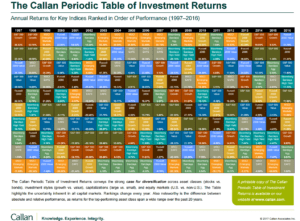
As you can see, there is no pattern or way to predict which asset class will do well from one year to the next. In the mid 2000’s, international and emerging market stocks were the shining stars while US stocks looked pretty pedestrian in comparison.
In hindsight, seeing where you should have invested is easy. Looking forward, the crystal ball becomes a bit fuzzy. Rather than getting caught up in the hype of what did well recently, a simple strategy is to invest in an allocation that is appropriate for your goals and risk tolerance and rebalance the portfolio to maintain that allocation over time.
What rebalancing means is sell the winners and invest the proceeds in the losers. Sounds counterintuitive, but it forces you to buy low and sell high. If we use 2016 as an example, large US stocks were up about 12% and international stocks were pretty flat. For simplicity purposes suppose you set up your portfolio to be 50% US stocks and 50% international stocks and you started 2016 with $100,000 in each asset class. By the end of the year, you would have approximately $112,000 in US stocks and still have $100,000 in international stocks. If the goal is to maintain a 50/50 split between the two, you will want to sell $6,000 of your US stocks and invest the proceeds in international stocks. This will bring your allocation back in line and you will now have $106,000 in US stocks and $106,000 in international stocks.
There is no telling what will happen in 2017 in this example – US stocks could post another solid year, causing you to wish you didn’t rebalance. But if international stocks grow and US stocks fall, you will be happy you made the move.
The point of rebalancing is to potentially capitalize on opportunities, avoid unnecessary risks, and most importantly keep your portfolio allocated appropriately for your investment goals.
In Summary
Ignore the news headlines, don’t try and predict the future, and invest in a diversified portfolio that is appropriate for your goals.
Have a great 2017 everyone!
Disclosures:
These are the opinions of Corey Janoff and not necessarily those of Finity Group or Cambridge Investment Research, Inc., are for informational purposes only, and should not be construed or acted upon as individualized investment advice. Any examples are hypothetical and for illustrative purposes only. Past returns are not indicative of future results. Any investment involves potential loss of principal.