

Written by: Corey Janoff
This post was originally published on our previous blog website on January 24, 2018 and has since not been revised and/or updated.
One of the more common types of questions I get starts with, “How much should I…?” People want to know how much they should save for retirement, save for children’s college, save for a home down payment. How much should I pay towards my student loans? How much extra (if any) should I pay towards my mortgage? How much will I need to retire? Today, we will focus on how much to save.
When trying to answer this question, we first need to answer several things:
- How much do you need (ie, what is your end goal)?
- When do you need it by?
- If we are investing the money, how much can we project the investment to grow by?
The third question is the most difficult to answer as we have no control over it. It is impossible to predict exactly how much any investment will grow by over time. But, we will need to estimate some figure in order to answer our initial question of how much to save.
How Much Do You Need?
Starting with the first question, which will set the stage for everything else, we need to figure out the total amount we will need to achieve our goal. If you read my blog post a few months ago, How Much Do I Need in Order to Retire?, you will have some general guidance on how to answer that question. Today, we can try to figure out how much we will need to save each year in order to hit that goal.
It doesn’t have to be retirement though. It could be something as simple as needing to save up for a 20% home down payment. Well, if the home you want to buy costs $500,000 and you need/want to put 20% down, you need to save up $100,000.
When Do You Need it By?
How much time do you have to accumulate savings until you want your goal to be achieved? If it’s retirement that you are shooting for, subtract your current age from the age you want to retire and there is your answer. So if you want to retire at 65 and you are currently 34 years old, you have 31 years to reach your goal.
This number could be a floating target, but most people have a timeline in mind for their goals. Also, the farther out you go, the more variables there are. Health changes could impact things. Economic changes could cause us to veer off course. Job, family, etc. I know, I’m not making this exercise any easier. If you want to be able to retire by 65 at the latest, shoot for age 60, so you have a five year buffer, just in case.
How Much Can We Expect the Investment to Grow By?
This is really just a big guess, because nobody can predict the future. Depending on your risk tolerance, optimism about the future, and time horizon for the investment, the number you are comfortable assuming could vary a bit. In the example I will give later, I will assume a six percent annualized rate of return for a long-term investment. Any given year the actual return could be significantly larger or smaller (even negative), but we will go with six for today.
How Much Do I Need to Save?
Drumroll….the moment we have all been waiting for. Below is a table that illustrates how much you will need to save each year. The vertical axis is the desired amount you want to have accumulated (Question 1). The horizontal axis is the number of years you have to accumulate that goal (Question 2).
Again, I am assuming we are investing the money saved each year into a diversified investment account that realizes an average annualized rate of return of six percent. Actual returns could vary. I assume you deposit the annual total in at the beginning of the year. If you invest monthly, or at the end of the year, the numbers will be a little different.
I am also assuming that you increase your savings rate by 3% (compound) each year to account for pay raises and inflation. If you earn more income over time, you should have the ability to save more in future years. The amount shown in the table is the annual amount you need to save starting today. Next year, you would need to save 3% more. The following year, you would need to save 3% more than next year. Makes sense? Good.
Lastly, I rounded the numbers. As the numbers get bigger, I rounded more to keep the table clean.
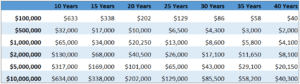
Annual amount to invest in order to reach total amount on left in time frame on top (assuming 6% annualized return) – annual amount invested increases by 3% per year.
Some Observations
It doesn’t take a rocket scientist to figure out that the longer you have to reach your goal, the less you need to save each year to get there. The less time you have to reach your goal, the more you need to save.
If you start with no money, want to retire with $5 million and only want to work for 25 years, saving $65,000/year adjusted for inflation will get you there. That is about $5,500/month. If you max out your $401k ($18,500/year), do a Roth Conversion IRA for both you and your spouse ($11,000 combined) and invest another $3,800/month in other investments, you will get there. I’m assuming that if you only want to work for 25 years with a (realistic) desire to retire with $5 million, you have a high income and the ability to save the above amount and then some.
If you are in your 20’s or early 30’s and plan to work into your 70’s, having over $10 million in investable assets is a very achievable goal. If you can start investing a hair over $40,000/year and increase that amount by 3%/year moving forward, you can get there!
Now, if you put off saving, wake up at 50 years old with no money saved for retirement and want to retire at 65 (this is sadly far too common for many Americans) and need $2 million to support your lifestyle in retirement, you will need to start aggressively saving $68,000/year. Keep in mind $2 million should give you the ability to live on about $80,000/year in retirement for 30 years (4% of the initial balance).
If your need $80,000/year to live comfortably, and need to save $68,000/year starting now, you better be earning about $200,000/year or more. $80,000 for lifestyle plus $68,000 for investing is $148,000. Don’t forget about $50,000 or more for taxes at an annual income of $200k.
In reality, if you have been earning $200,000/year and haven’t invested a lick by the age of 50, you will be used to a $200,000/year lifestyle and won’t be happy scaling down to $80,000/year in retirement. Also, saving a third of your gross income is challenging, but you are going to have to do it. If you had made saving a priority since you started working, saving a third of your income at $200k/year would be a piece of cake. If that was the case, you wouldn’t wake up at age 50 in a panic.
So, moral of the story is: DON’T DELAY! Be proactive and start investing now! Yesterday would have been ideal.
Print this table, tape it to your desk and use it as motivation. How much do you want? How much time until you want it? Bam! Now you know how much you need to be saving in order to get there.
Disclosures:
Any examples are hypothetical and for illustrative purposes only. Any investments involve potential losses, including total loss of principal. Consult your financial advisor before implementing an investment strategy or making any investment decisions.